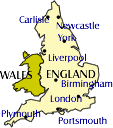
GENERAL INFORMATIONThere are very few hotel chains in the UK. What ones there are will be found only in or around large cities. Heathrow airport sports the best selection of brand name hotels but due to bed construction these might not offer a good nights sleep either. The hotel chains are there to accommodate the business traveler not the tourist so dont expect them to be in areas that you want to travel, sometimes you can be fortunate and they will overlap but dont expect it. Areas like Portsmouth sport a Hilton, Hyatt and Posthouse hotels which are reasonable chains but once you begin to move out into the smaller towns and countryside they vanish too. Posthouse do claim to have hotels in some of these outlying areas but care must be taken as they have two classes of hotel, their new chain hotels and the older inn like places. These are quaint but not conducive to a good nights sleep. Often in renovated (or not renovated) old pubs or inns, these places may not be large and often sport beds of similar age to the house. NOTE: Posthouse were recently purchased by a new hotel chain, and are under management change. Under the old establishment they were a good chain to go with but I am undecided if the change is for the better. On my last trip I stayed in one Posthouse and was very unimpressed, the service and rooms had gone downhill considerably since my last visit only two years before. If you want to go exploring into the more rural areas of the UK only small hotels and guest houses will be available. These can look very quaint and delightful to an American who is not used to the old country ways (I was raised in one of those quaint villages so they dont hold the same fascination for me). However the of smaller hotels (all of which will be old, thats just the way it is there) do not consider bed quality to be a high priority. The mattresses are rarely changed and often are in a very poor state. They may have spring protruding, large hollows in the center and squeak terribly when you get in to be followed by a loud PONG noise as yet another spring finds a new position or lets go. Even people who live there will often avoid hotels as the bedding can be so uncomfortable that sleeping on the floor is preferable. In addition the rates they charge are very high considering what they are offering. If you are interested in the experience of an old creaky building in a quaint town it might be fine but it will usually soon warse. As I said before most of the larger buildings are old and they are not easily maintained. The floors are wooden so every movement from anyone causes an avalanche of squeaks and groans. The plumbing can be incredibly noisy also, one place I stayed, every time the water was turned on the whole area shook and a huge knocking sound would reverberate through the walls. This went on all night as people around the hotel used the bathrooms. Be aware also that most of these older places unless they have been modernized for the overseas tourist, will still have the bathrooms located at the end of the corridor. Quite a few recently been modernized but many of the older and smaller places have not. These may be quaint but you will have to share a bathroom, although you may be lucky enough to get a washhand basin in your room. This does make those dead of night visits to the bathroom much more inconvenient and if everyone gets up about the same time in the morning you might well have a long wait before you can get into the bathroom at all. The huge expense and poor qualityof hotel accomodation is the main reason that there are so many trailers (or caravans as they are called there) in the UK. Anyone who wants to travel there usually goes by trailer or camping as it is the only economic way to vacation with the family, or even two people if you want to travel. If you visit in summer you will see a huge parade of these white objects every where you go along with a vast array of small caravan parks over the whole of the country. The hotels are left to the business people. overseas tourists, and rich Britons who dont understand how poor the quality is as they have never experienced anything else.. The only main exception to this rule is the seaside town hotels. ![]() BEACH SIDE HOTELSThese are still exactly as described above but since people like to visit the ocean in the summertime they will take a week in a seafront hotel. It is important to understand that by British mentality their country is rather large (its all relative to what you are used to.) A weekend trip to the seaside is considered far too far for the average person to drive, even though by American standards it is not very far in miles at all. However America has many wide fast roads to ease travel, while in Britain all coastal areas are accessed by smaller town and country roads, which are narrow and more congested. It does therefore take considerably longer to reach a point only 30 miles away than it would do here, think of it as driving in city traffic most of the time, and you get an idea of the speed of travel. Therefore many people from the midlands and central area of the country only visit the seashore once a year. This is their annual vacation or holiday as it is called there, and they will book a shorefront hotel and stay there for the week. Sometimes returning to the same hotel year after year for 20 or 30 years! In the seaside town where I grew up it was common to meet other children of 7 or 8 who had never seen the sea before, and although that might be common in the US since its a LONG way to the coast from the inland states, it is quite surprising in such a small island. For this reason seaside hotels are usually very expensive. Usually they dont offer any of the features we come to expect for a more expensive motel, - the bathrooms are still down the hallway in most cases - maintenance is often still poor, the plumbing is old and noisy and of course the beds are old, creaky, worn, usually with old sagging mattresses or, if upgraded wads of that dense foam which is so bad for back sufferers, but nice and cheap for the hotels. Rooms are usually basic and dont even come into the antique furniture and rustic style category, unless you consider antique anything that is old, but that does not mean well kept or nice. Rooms are often sparse, shabby and bleak. Heating for colder nights is often very poor so its quite easy to freeze especially if you dont arrive high season, and considering the British weather its still possible to freeze then. There will be no room controls for heat, it will all be controlled from a central boiler somewhere (this is common in all British hotels not just seaside ones). Most often they have seasons for heating after a certain date the heat is turned off no matter how cold it is or gets. It will not be turned on again until the specified date in the fall when its heating season once again. Overheating in the summer was never usually a problem since it rarely became very hot. However in recent years this has changed and it often reaches the 90° and 100º F although the humidity stays low. None of the seaside hotels will offer air conditioning so you will likely cook, even the upmarket business hotels that do sport it often turn it off at night!. In most cases few rooms in these hotels will offer a sea view (see location and parking), there will be no extra facilities like a swimming pool, health facilities or other such items. Virtually all are just basic rooms, although they will all sport a bar and most likely a dining room. Most seaside hotel stays come as a package of at least bed and breakfast. In many cases dinner will also be included so its one stop shopping. Until recently there were few restaurants in Britain so eating out in the evening could be a problem, however with the changing of the licensing laws pubs have begun to renovate and include good food facilities so eating out is less of a problem. Breakfast can still be more difficult to come by so a package that includes it is often the best deal. Many seaside hotels shut for the winter and the owners move to warmer climes (Majorca used to be the favoured spot) therefore if you wish to travel at this time of the year be aware that your choice of facilities may be more limited. The more upmarket hotels on the seafront usually stay open all year round, but most of the tourist hotels are closed. Upmarket does not mean better just more expensive. All come into the same category I have described above, its just that they are larger and cater to the older Brits who come to the seaside out of season to enjoy a break. This of course is more likely on the south coast of England than in the north where more hotels will close. All towns will have a few, but only a of few of the multitude available in summer. Maintenance never seems to be high on the list nor making the facilities more appealing or attractive. Hotels rely on their location and the fact that the British never seem to complain to charge high prices for poor facilities. Also since most British people have never seen a quality hotel they accept their lot as thats the way it is and put up with it. So if you wish to visit such places you might want to do a little shopping around before you settle. If you want to see such parts of the country there is little other choice unless you try bed and breakfast. Finding one with a suitable bed for a bad back could be difficult if not impossible, be prepared for this if you want to travel to the more rural areas. ![]() LOCATION.In seaside towns hotels are close to but not on the beach. Due to the free beach laws in Britain hotels cannot be built on or restrict access to the beaches. So in virtually all cases this means on the other side of the main beach road. In most towns a road will run along the beach front and in the town center a promenade will stretch between the shore and the road. This is rather like what Americans would call a boardwalk but it is usually asphalt or concrete for durability. Almost every seaside town will have one, and they can range in length from a few hundred yards in tiny villages to several miles in larger towns. All the hotels will be located on the other side of boardwalk and road. Thus the amount of rooms that have a sea view are quite small. Many towns also have small squares with a parks in the center indented along the seafront and the hotels will be arranged around these. In these of course no one gets a sea view, but all are only a few steps from the beach and thats all that matters to most Brits. The beach front is most often a long terrace of buildings which front the beach at least in one part of the town. This is most often made up almost entirely of hotels, many of which are just seasonal and will be closed in the winter months while their owners bask in the Mediterranean sun before returning for the next hectic season. The line of hotels will be broken only by an occasional night club or ice cream parlour. The main part of the town with the stores and souvenir shops is usually located on a different spot from the promenade. In larger towns the town center can be a considerable distance from the beach front. Most hotels on the beach front will be part of the terrace and sit side by side with others just like them. They are usually three of four story structures built 50 to 100 years ago, maybe more. If you want a more individual hotel you will need to travel outside the town itself. Here depending on the town the hotels may or may not be located within walking distance of the beach, (walking distance usually means half a mile or less but can be as much as a mile, check first.) Also be wary of stones throw from the beach this could be over the clifftop. Although such locations do usually offer very scenic views, access to the beach can be down a lot of steps or packed dirt cliff path which might not be your idea of beach front. A lot of Britain is very hilly so seafront properties can dip up and down quite considerably. In the town where I grew up the largest hotels with parking facilities were up on the hill, although access to the beach was easy it was up and down (across the road of course) and could be a problem for those not use to walking even short distances and especially up hills. Dont expect that you can take your car to the beach, parking in such areas is impossible. ![]() |
|
Contact us |
![]() |